Deciding between private vs hosted AI for customer help with SendGrid requires balancing strict data governance against operational agility and infrastructure cost. Engineering teams must determine whether sensitive customer inquiries, order records, and account context should be dispatched to external provider APIs or processed within a dedicated, self-hosted model boundary behind an authenticated ingestion pipeline.
At Canvas Developers, our engineering approach treats customer support automation as a deterministic system. By establishing clear data boundaries, structured payload sanitization, and verified escalation channels, engineering leaders can safely evaluate hosted convenience against private model ownership without jeopardizing customer trust or message delivery reliability.
Evaluating Private vs Hosted AI for SendGrid Customer Support
Selecting between private vs hosted AI for customer help with SendGrid centers on data control, operational complexity, and infrastructure expenditure. Provider-hosted APIs deliver rapid access to advanced reasoning models without specialized GPU provisioning. However, transmitting unredacted support correspondence across third-party commercial APIs introduces compliance exposure and variable token charges that expand alongside ticket volume.
Conversely, establishing a private LLM support workflow in an isolated environment grants full control over customer records and data boundaries. Customer tickets containing transactional references remain strictly inside internal networks, meeting enterprise data governance standards. Although self-hosted open-weight models require fixed compute allocation and operational oversight, they protect support pipelines from external provider downtime, rate limiting, and third-party policy modifications.
At Canvas Developers, our approach separates production runtime inference from internal coding tools. Engineering teams must weigh predictable server costs against the flexibility of managed provider APIs. Through our AI engineering packages, we assess these trade-offs against baseline response quality and infrastructure requirements to ensure the chosen deployment satisfies strict operational constraints.
Support Workspace Screens and Human-in-the-Loop Review States
Unified Operator Inbox and Customer Context Drawer
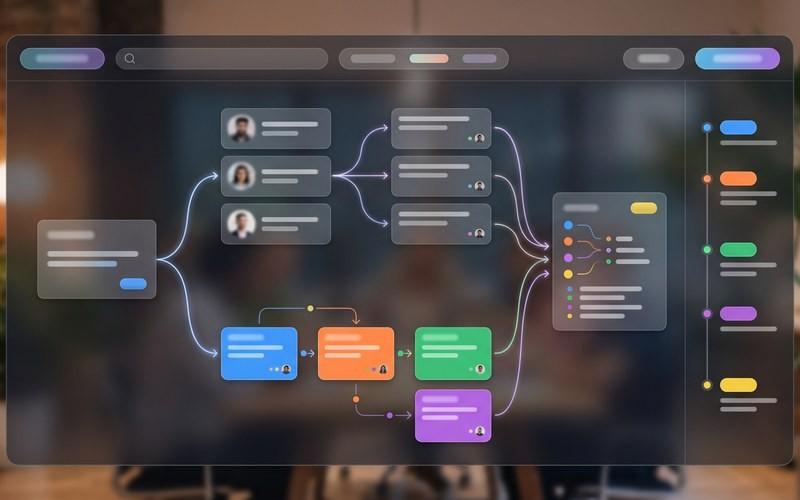
The operator interface serves as the primary operational surface for support personnel. When an inbound inquiry arrives through SendGrid, the triage screen presents a unified view featuring the email thread, detected intent, and a customer context drawer. This drawer retrieves sanitized account context—such as subscription status, permitted order identifiers, or booking timestamps—from internal databases, displaying verified records directly beside the conversation.
Operators inspect the auto-generated response draft generated by the inference service. For teams evaluating SendGrid private vs hosted ai for customer help, the workspace renders token provenance and inspected payloads, allowing engineers to verify that no unauthorized customer identifiers or payment credentials were exposed during model processing.
Confidence Scoring, Edge Cases, and Manual Escalation Trays
Every incoming message is assigned a deterministic confidence score calculated against model log probabilities, semantic classification thresholds, and schema validation checks. When a score falls below established operational benchmarks—or when sentiment analysis detects critical dissatisfaction—the workflow automatically triggers an AI email response fallback.
In this fallback state, the system withholds automated outbound transmission and routes the draft directly into a manual escalation tray. Support personnel review the flagged inquiry, inspect missing or ambiguous booking attributes, adjust the suggested text, and approve the final dispatch via SendGrid's outbound mail API. This human-in-the-loop review state maintains message accuracy and prevents hallucinations from reaching customer mailboxes.
Data Boundaries, Payload Mapping, and Phased Migration Strategy
Inbound Parse Sanitization and Permitted Field Routing
Incoming customer emails arrive via SendGrid's ingestion pipeline, which processes inbound messages and posts multipart/form-data payloads to our application endpoint as outlined in the SendGrid Inbound Email Parse documentation. Operating an effective SendGrid inbound parse webhook AI integration requires strict sanitization before inference. The webhook handler verifies ECDSA signatures, parses the multipart payload, and validates SPF and DKIM headers before extracting the raw text body.
To enforce customer support data boundaries, our ingestion middleware filters the message against a strict schema mapping. The service isolates permitted transactional fields—such as order numbers, booking references, and fulfillment dates—while discarding raw attachments, credit card details, and superfluous metadata. Only explicit, schema-validated parameters and sanitized conversation snippets enter the inference payload, ensuring both private LLMs and hosted provider endpoints receive only the minimum necessary data to resolve the ticket.
Dual-Run Shadow Validation and Reversible Cutover
Migrating from an existing legacy ticketing system demands a disciplined, controlled transition. Our engineering decision relies on a dual-run shadow validation phase. In this state, the webhook forwards inbound correspondence concurrently to the legacy support queue and the AI inference engine. The model generates proposed replies into an internal audit table without dispatching outbound emails, allowing operators to benchmark accuracy and hallucination rates against real operator resolutions.
Once shadow evaluations meet acceptance thresholds, we execute a phased support AI cutover. Message routing shifts progressively by category or customer tier. If anomaly detection flags elevated error rates, our SendGrid integration architecture initiates an automated rollback, reverting traffic to human dispatchers. Prerequisites include verified MX records and schema-compatible database connectors, while technical limits reflect SendGrid's 30 MB message threshold; engineering plans must explicitly account for network latency without promising zero downtime or zero data loss.
Acceptance Testing, Model Benchmarking, and Engineering Assurance
Rigorous acceptance testing AI support workflows ensures both local and provider-hosted architectures deliver reliable resolutions before handling live email traffic. When benchmarking SendGrid private vs hosted ai for customer help, our engineering team executes an identical suite of sanitized support scenarios across both deployment models. This benchmark evaluates adherence to permitted booking fields, JSON schema validity, token latency, and hallucination rates under identical prompt constraints.
Our acceptance checklist focuses on core integration gates:
- Signature Verification: Confirming SendGrid webhook requests validate cryptographic signatures before reaching application logic.
- Data Boundary Auditing: Ensuring raw email headers and non-permitted account fields are filtered prior to inference.
- Fallback Activation: Verifying inquiries with low confidence scores route reliably to manual operator review trays.
- Template Conformity: Testing that outbound responses adhere strictly to approved corporate design and transactional schemas.
To accelerate implementation, Canvas Developers utilizes AI coding agents to scaffold webhook parsers, schema validators, and test suites. This automation shortens feedback loops and reduces initial delivery effort, while experienced engineers own architecture reviews, security auditing, and production cutover decisions. For standard booking inquiries, deterministic rules remain preferable to generative inference, eliminating unnecessary compute overhead.
Scoping Your Support Migration with Canvas Developers
Executing a reliable private vs hosted ai for customer help migration plan requires aligning infrastructure constraints, privacy boundaries, and operational goals. Canvas Developers partners with engineering teams, startups, and established businesses to evaluate self-hosted model feasibility, design secure SendGrid Inbound Parse pipelines, and establish deterministic fallback safeguards.
Our engineering team directs each engagement through clear technical scoping, agreed delivery milestones, automated acceptance testing, and complete architecture handover. We help organizations balance development velocity with rigorous code review and data security. We invite founders and technical leaders to discuss their current email infrastructure, support volume, regulatory constraints, and target outcomes by submitting an enquiry through our contact form to schedule a scoped engineering assessment.