Product Design & UI/UX
UX Research
Learn what your users need before you design or build. We interview real users, review the analytics and support data you share, and turn the evidence into clear priorities.

Who commissions UX research
You have ideas for what to build next, but no clear picture of the problems users actually have or how they deal with them today.
- Founders checking whether a problem is worth building a product around
- Product managers choosing between competing roadmap bets with little evidence
- Teams designing for an unfamiliar user group, such as admins or field staff
Research that answers real product questions
Many products are designed from assumptions: what stakeholders believe, what a competitor did, what a few vocal customers asked for. UX research replaces guesswork with evidence. We interview real users, run surveys and review the analytics and support data you permit us to use, then connect the findings to the decisions in front of you. It suits new products, redesigns and features that underperform. Research can be engaged on its own; design, development and hosting are only included if you add them.
AI-assisted synthesis, researcher-verified findings
How AI assists
- Drafts interview guides, screeners and survey questions from your research goals, for researchers to refine.
- Transcribes consented interviews and tags themes across transcripts, survey answers and support tickets.
- Groups recurring problems and links each one back to the quotes, tickets or data points behind it.
- Summarizes the analytics exports you share to show where users drop off, hesitate or repeat steps.
What our experts own
- Researchers set the questions, choose the methods and decide who to recruit and how consent is handled.
- Interviews are real conversations with your users, run by our researchers. We never invent participants or quotes.
- Every AI-suggested theme is checked against transcripts, tickets or data before it appears in a report.
- Personas and journey maps come from observed evidence only. AI-generated personas are never presented as findings.
One research cycle, question to decision
Typical cycle for an interview study; methods, sample and timing are set in your research plan.
Questions
Each question is tied to a decision your team must make; questions without a decision are dropped.
Checkpoint: Decision owners agree the questions
Recruit & consent
A screener selects participants who match the user groups; each one agrees how recordings and quotes are used.
Checkpoint: You approve the screener before outreach
Sessions
Researchers run live conversations from a discussion guide, asking for recent real examples rather than opinions.
Synthesis
AI drafts transcripts and candidate themes; researchers drop any theme they can't trace to a session.
Checkpoint: A researcher signs off every theme
Findings
Each finding links to consented quotes and recordings, notes how often it appeared and flags open questions.
Decisions
Your team decides what to build, change or drop; we record which finding informed each decision.
Checkpoint: Your team owns the product decisions
When something fails: If recruitment falls short or early sessions show we're asking the wrong questions, we pause and revise the plan with you.
How a research engagement runs
- 01
Define the questions
We agree the decisions research must inform, the methods and participants, and which data you permit us to use and how it is handled.
- 02
Collect evidence
Researchers run interviews and surveys and review analytics and support data. Sessions are recorded only with participant consent.
- 03
Synthesize and verify
AI helps transcribe, tag and cluster the material. Researchers check each theme against its sources and decide what the evidence supports.
- 04
Share and prioritize
You get the report, personas and journey maps in a walkthrough with your team, with recommendations ranked by impact and effort.
Two ways to work with AI tools
AI helps synthesize permitted research and explore designs. Choose where it may process your research and files.
- Private / Local AI Engineering
Privately hosted models inside infrastructure you control or an agreed isolated environment.
Discuss with this package - Claude Code / OpenAI Codex Engineering
Claude Code and/or OpenAI Codex with cloud settings your organization approves.
Discuss with this package
Not sure? We'll recommend one during scoping. Compare AI delivery options
What you receive
Research outputs your team can act on
Research plan
The questions to answer, the methods, who to recruit, and how consent and data are handled. Agreed with you before anyone is contacted.
User interviews
One-to-one sessions with current or prospective users, recruited and moderated by our researchers, with recordings and transcripts where consented.
Surveys and analytics review
Survey design and analysis, plus a review of the analytics, heatmaps and session recordings you permit us to use, to see how widespread a problem is.
Competitive UX review
How comparable products handle the journeys that matter to you: conventions users already expect, gaps you can fill and patterns to avoid.
Evidence-based personas and journeys
Personas and journey maps built from what users said and did, with pain points at each step and every claim traced to its source.
Findings and recommendations
A report with evidence, severity and recommended next steps, walked through with your team and ready to become design priorities and user flows.
Typical research requests
Typical scenarios we scope, not client case studies.
Checking AI-generated personas against real users
A team built personas with an AI tool and is planning features around them. We would treat each attribute as a hypothesis, interview real users to test it and keep only what the evidence supports, labeling the rest as open questions.
Users finishing their work in spreadsheets
Analytics show heavy use of the export button, and nobody knows what happens next. We would interview the people exporting, ask them to show their spreadsheets and learn which missing capabilities they are working around.
A large customer asking for a feature
A large customer insists on a feature, and the team can't tell whether others need it. We would interview a mix of customers and review support and usage data to learn whether the underlying need is common before anything is designed.
What UX research doesn't include
- Testing whether a specific prototype or live screen is easy to use is User Testing; research comes earlier and asks what users need.
- Turning findings into flows, wireframes and clickable screens is Wireframing & Prototyping; the research report sets that work's priorities.
- We review the analytics you already collect; setting up tracking, tags or dashboards is Analytics & Reporting.
- Market sizing, pricing studies and brand surveys are outside this service, which studies how people use and need a product.
How research carries into design, QA and launch
Design starts from evidence
Findings become user flows, priorities and design questions. If we design the product too, our designers work from the same evidence, not a summary of it.
Clearer requirements for engineers
Research surfaces edge cases, user roles and real-world data early, so developers estimate and build against how people actually work.
QA tests the journeys that matter
The tasks users depend on most become usability and accessibility checks in QA, so testing focuses on the journeys your research showed are critical.
Research continues after launch
After release, analytics, support tickets and follow-up interviews show whether problems were solved, and feed the next round of improvements.
FAQ
Frequently asked questions
Do you use AI-generated personas or synthetic users?
Not as evidence. AI may help us summarize and draft from the research you permit us to use, but every persona attribute and journey step must trace back to real interviews, surveys, analytics or support data. If we use AI to explore hypothetical scenarios, we label them as assumptions to test with real users, never as findings.
Can you recruit research participants?
Yes. We write the screener and recruit from your customer lists, your product's users or an external recruitment panel, then schedule sessions and manage consent. Incentives, and who pays for them, are agreed during scoping. For specialist audiences, we check recruitment feasibility before the plan is final.
How many participants does a study need?
It depends on the question. To learn why people struggle, a small number of interviews per user group usually reveals the recurring problems, and several small rounds teach more than one large one. To measure how common a problem is, you need a survey or analytics with a larger sample. We recommend sizes in the research plan, before recruiting starts.
Where is research data processed when you use AI tools?
Only where you agree. Before work starts, we confirm which data we may use, how recordings and personal details are anonymized or excluded, and which tools may process them. The choice mirrors our development packages: Private / Local AI Engineering keeps processing on privately hosted models; Claude Code / OpenAI Codex Engineering uses commercial providers under agreed account and retention settings.
Related case studies



Related projects



Related articles


Related Services

Vibe Coding Consulting & Governance
Architectural guardrails, automated testing enforcement, and code audits for AI-generated codebases....
Learn more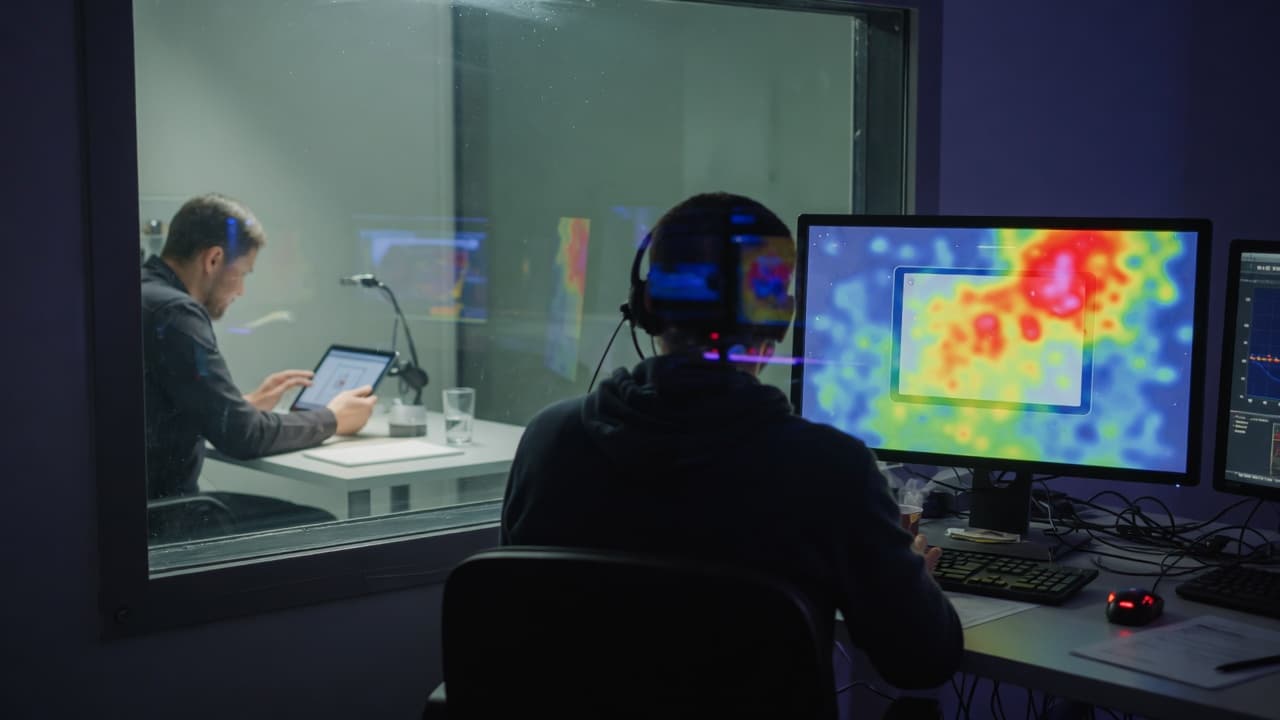
User Testing
See where real users struggle with your product, and why. We run usability tests on prototypes and l...
Learn more
Wireframing & Prototyping
Test your product idea before you pay to build it. We map user flows, wireframe key screens and buil...
Learn more
Design Systems
One shared source for how your product looks and behaves. Tokens, components and documentation that ...
Learn more
Base your next decision on real user evidence
Tell us what you need to decide. We'll suggest the research methods and scope, whether research runs on its own or leads into design.